Don’t fear unknown words
(Note: With this post I just want to share thoughts and tips based on my own experiences and observations. If you have a different opinion that's fine. Language learning is an very individual process. Everyone has different goals and preferences. Try different things and do what works best for you.)
Reading is an effective way to increase your vocabulary. But the really interesting books are often very difficult for a language learner (especially if you have little to no experience with native level books). Looking at a page full of unknown words can be intimidating. And if it’s a physical book, reading even a few pages takes ages if you need to look up many words. Reading texts above your current level can be slow and difficult.
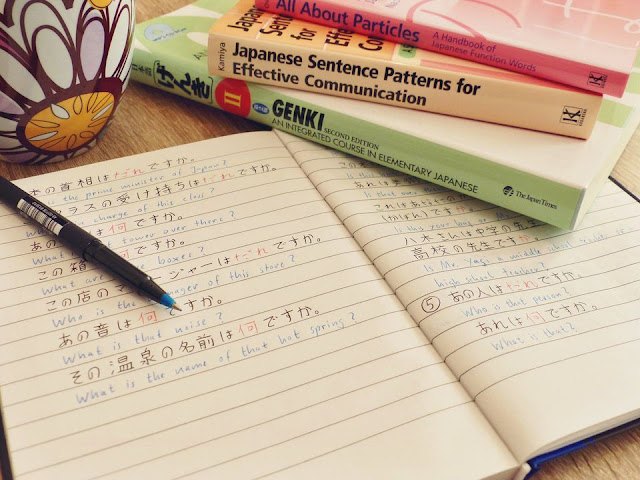
From time to time I see language learners who tend to avoid books for natives and keep studying from textbooks or apps to “prepare“ themselves until they are “ready“. And I understand their decision. Textbooks and language learning apps provide structure and present the language in manageable chunks. They are an important first step and they can be a great resource for intermediate learners. Please use them to learn the basics and as a reference but keep in mind that they can only get you to a certain level.
Why Textbooks Aren’t Enough
It’s obvious, but books for native speakers are not written with language test levels in mind (in the case of Japanese the JLPT). A book for natives can contain words of all levels. For example: The language used in books for a young audience is usually easier than for adults, but even books for kids can contain words that are not in your textbook. On the other hand, novels for adults contain not only abstract and specialized words but also many common words you probably already know. To put it simply: There are no strict levels in the "wild". That’s why you need to learn to deal with the language outside of textbooks.
These resources help but they just can’t teach you everything. I mean, it would be extremely unrealistic to expect that you just need to study enough textbooks or completing all levels of your language learning app and then you are able to understand any novel for adult natives without look ups.
Diving Into Native-Level Books
If you want to learn to read at the level of an adult native speaker, you need to face this challenge and start reading these books at some point — and I mean many of them. No matter how much you prepared yourself through textbooks and apps, you will run into a ton of new words and phrases. This is intimidating at first, but there’s no way around it.
You learn simply as you go by trying your best to understand and looking up words, phrases and grammar points. If you are only used to textbooks and apps, it’s absolutely normal that you struggle for quite some time. Don't worry! It gets easier the more you expose yourself with content for native speakers.
What is intimidating today will feel normal for you in the future. Keep going, don’t fear challenges, be open minded and take your time — and you will be able to tackle more and more difficult content.
Tips and recommendations

I myself am at a point where I’ve read more than 100 books in Japanese. Many of them were manga, the rest were light novels, novels and a few non-fiction books. The level of difficulty of these books varies. I started with easier books and tried to read more and more challenging ones. I also regularly play video games in Japanese. A few examples:
Manga
- 名探偵コナン (has full furigana, it’s quite challenging but you’ll learn a ton of expressions and words from a wide range of real wold topics, strongly recommend it)
- ナルト (typical battle shonen manga, full furigana, much easier than コナン)
- Silver Spoon (full furigana, lots of specialized vocab and therefore difficult, but also very fun)
- バクマン (since I draw manga myself this is one of my favorites, very enjoyable but also very challenging)
- らんま 1/2 (I love this series, it has full furigana and is one of the easier manga I've read so far; just be prepared that it contains a bunch of "fantasy" words like attack names etc.)
Novels and Light Novels
- ハイキュウ 小説版 (this was challenging at first because the author uses a quite rich vocabulary, the stories are not very complex though)
- 名探偵コナン (I’ve read several novel versions of the Detective Conan movies, the writing style is quite easy to understand, they cover various topics and they have full furigana, I strongly recommend them)
- ハリー・ポッター 1 to 4 (the beginning was hard and sometimes I was a bit lost what happens but the overall difficulty is okay; there are also audiobooks on Audible)
- 変な家 (I really enjoyed this one, the first chapters are quite easy, only the last one was suddenly very difficult)
Games
- Animal Crossing (easy and relaxing game, full furigana)
- Ace Attorney (one of my favorites, no furigana, challenging at first but now at Ace Attorney 3 I can play it with only occasional look ups)
Even though I’ve read quite a number of books, I’m far from fluent. I'm currently reading アクセル・ワールド, 1Q84 and ハリー・ポッターと不死鳥の騎士団. Even with all my experience, there are many new words in all of them. Maybe I should be better at this point, but it is what it is.
However, this is no reason to panic. I think that it’s important to not fear unknown words. New words are not a barrier, they help you grow. Instead of worrying about all these unknown words I take my time, look up words and follow the story. I can enjoy these books even though I don’t understand everything and need to look up many words.
To me, it’s about the journey, not the goal.
Some tips and strategies
Graded ReadersRead what you know
Pick a book you’ve already liked reading in your native language (or after watching the movie). This way, you can be sure that you will like the story. This makes looking up many words more bearable. Plus, knowing the story makes it easier to understand the novel in your target language.
Ebooks
If possible, choose the ebook version. Reading digitally makes look ups faster and therefore less frustrating. Because it’s almost effortless you can look up many words without burning out. And by looking up more, there are more opportunities to learn new words.
Look-up Limits
Decide how many words you want to look up per page depending on your needs. Looking up words digitally is fast and almost effortless. This way it’s not hard to look up every word you don’t know. But if this is too much for your taste, just set a limit that makes reading more comfortable for you. You could try to look up only the 3 most important/interesting words per page and see how it goes. Change the number depending on how you feel or how difficult the book is.
Don't worry about perfection
It’s okay to not understand 100%. Progress is better than perfection. As long as you read regularly and look up at least some new words, your vocabulary will grow. Don’t worry too much about every single word you don’t know.
Don't rely too much on the dictionary
Being able to guess words from context is a valuable skill. Try to understand from context first and look up what seems necessary afterwards.
Push through the first chapter
Don’t let yourself get discouraged right away just because you encounter several new words per page. If you start a new book, try to read at least the first chapter. The prologue and the first chapter are usually the hardest, because you need to get used to the authors writing style and the story.
Take your time
Take as much time as you need. If you lack vocabulary, reading speed is nothing to worry about at this stage. Build up your vocabulary first.
Difficuty varies
Even if the overall level of difficulty is okay, there can always be paragraphs or chapters where your comprehension suddenly drops. That’s completely normal. Do your best to understand the gist, look up some words and then move on. Focus on the things you can understand.
Focus on words that appear regularly
You don’t need to learn everything the first time you read a book. Don’t worry too much about rare and specialized words, yet. Try to focus on more common words first. Since they come up more often and in different books, they are more useful at this point. Later when you are more advanced, looking up and learning these rather rare words is less overwhelming than in the beginning where everything is new.
Anki as a supplement
A flashcard program like Anki helps to remember words you've encountered during your reading sessions. But instead of adding all new words I recommend to add only words you've seen at least a few times. Personally, I like my cards simple and put the Japanese word together with an example sentence on the front and reading and meaning on the back.
I use it only as a supplement. My daily Anki sessions are between 10 - 15 minutes long. I want to use most of my learning time for reading and listening -- this is where I really learn new words (= by repeatedly seeing them in context). Anki just helps me to build up familiarity with words I already recognize. Anki is not a must, of course. If you really can't stand it, don't use it. Just make sure that you read and listen regulary.

Comments
Post a Comment